Hammer Mill: Efficient Coarse and Fine Size Reduction for Laboratory and Industrial Applications
INTRODUCTION:In material processing, achieving the correct particle size is essential for accuracy, efficiency, and product quality. In both laboratory and small-scale industrial environments, hammer mills are widely used for reliable coarse and fine size reduction. Their ability to process medium-hard and brittle materials with consistent output makes them a preferred choice across many industries.
A Hammer Mill is designed to pulverize small quantities of laboratory samples, typically up to 5 kg per hour. It can reduce a maximum feed size of –5 mm into a fine output of up to 212 microns, making it ideal for sample preparation prior to testing or further processing. The equipment supports both batch and continuous operation and is known for its ease of use and dependable performance.
What Is a Hammer Mill?
A hammer mill is a mechanical size reduction machine that uses rapidly rotating hammers to crush and grind materials through a shearing action. It is specifically suited for medium-hard and brittle materials and is commonly used in laboratories, pilot plants, and various industrial applications where controlled pulverization is required.
The simple and robust construction of a hammer mill ensures consistent grinding results with minimal operational complexity, making it suitable even for routine laboratory use.
Working Principle of a Hammer Mill
The hammer mill operates on the principle of shearing, assisted by high-speed rotational impact. Material to be crushed is fed into the pulverizing chamber through a hopper, ensuring uniform delivery into the grinding zone.
Once inside the chamber, the material encounters high-speed rotating hammer arms. The centrifugal force generated by the rotating hammers causes the material to be broken down by shearing action between the rotating hammer arms and the fixed toothed circular inserts. This continuous action reduces the particle size progressively.
As the particles become smaller than the openings of the sieve positioned underneath the grinding chamber, they pass through the sieve mesh and are collected in a stainless steel container. This ensures controlled particle size and clean sample collection.
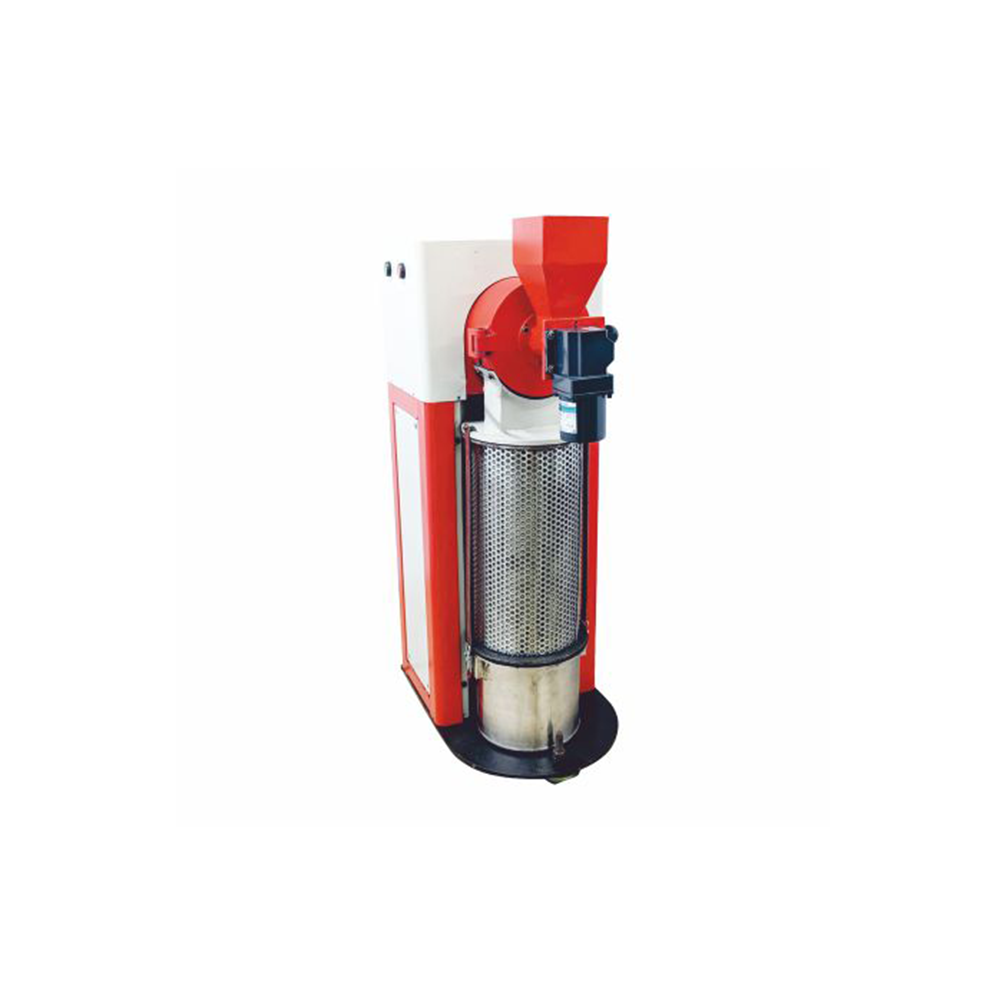
Features of a Hammer Mill
Hammer mills are capable of both coarse and fine size reduction, providing flexibility for different applications. They are suitable for processing medium-hard and brittle materials and support both batch and continuous modes of operation.
The equipment is easy to operate and requires minimal supervision. Critical components such as the rotor and grinding teeth are manufactured from hardened steel to ensure long service life and resistance to wear. Interchangeable sieves allow users to achieve different final particle sizes based on testing requirements.
Technical Specifications
The hammer mill is used primarily for size reduction applications. It processes medium-hard and brittle feed materials with a typical feed size ranging from 5 mm to 10 mm. The achievable final fineness is less than 212 microns, depending on the sieve used.
Operating at 2800 RPM at 50 Hz, the hammer mill delivers efficient and consistent grinding. The rotor and grinding tooth or station are made from hardened steel, with alternative materials available upon request.
Available sieve sizes include 1 mm, 500 microns, and 212 microns, with custom sieve sizes available if required. The stainless steel collector has an approximate capacity of 5 liters, suitable for laboratory sample quantities.
The system is powered by a 2 HP motor and operates on a 3-phase, 415 V, 50 Hz power supply. Power consumption is approximately 1.6 kW, with electrical protection provided by a 4-pole MCB. The compact dimensions of 680 x 1070 x 530 mm, along with a net weight of approximately 150 kg, ensure stability and efficient use of space.
Applications of Hammer Mills
Hammer mills are widely used across several industries. In the mining and mineral sector, they are used for crushing coal, ores, and mineral samples before analysis. In the chemical industry, they help pulverize raw materials for uniform reactions and formulations.
The food industry uses hammer mills for grinding grains, spices, and brittle food ingredients. In the cosmetic industry, they are used to produce fine powders required for product formulation. Hammer mills are also used in the construction industry for size reduction of brittle materials and in laboratories for sample preparation prior to analytical testing.
Advantages of Using a Hammer Mill in Laboratories
In laboratory environments, hammer mills ensure consistent and repeatable sample preparation. Uniform particle size improves the accuracy of analytical results and reduces sampling errors.
Compared to manual crushing methods, hammer mills save time, reduce labor, and improve safety. The enclosed grinding system minimizes material loss and contamination, making it suitable for precision testing laboratories.
Maintenance and Best Practices
To maintain consistent performance, the grinding chamber should be cleaned after each use to prevent material buildup. Sieves must be inspected regularly for wear or clogging. Hammer arms, rotor components, and bearings should be checked periodically, and lubrication should be carried out as recommended.
Electrical connections should be inspected to ensure safe operation, and the machine should be kept in a clean, dry environment when not in use.
Conclusion
A hammer mill is an efficient and reliable solution for coarse and fine size reduction in laboratory and small-scale industrial applications. Its ability to process up to 5 kg per hour, reduce materials from –5 mm to 212 microns, and handle a wide range of medium-hard and brittle materials makes it an essential piece of equipment in mining, chemical, food, cosmetic, and construction industries.
With its simple operation, durable construction, and precise size reduction capability, the hammer mill plays a vital role in accurate sample preparation and material processing.